
World's largest liquid scintillator neutrino detector, JUNO, begins operation in Guangdong
2025-08-27 21:40:56
|
来源:CHINADAILY
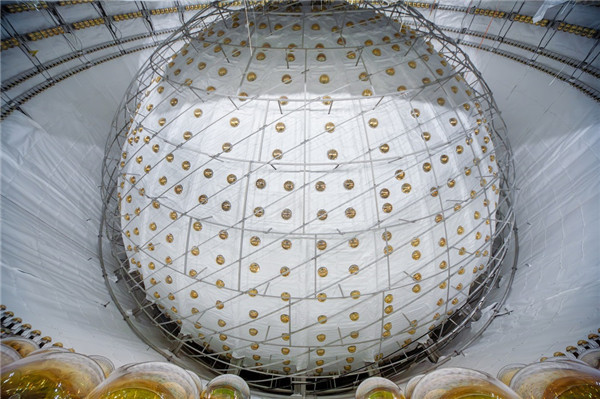
The JUNO detector seen from outside. [Photo provided to chinadaily.com.cn]
The world's largest transparent spherical neutrino detector completed its liquid filling and began data taking in Jiangmen, South China's Guangdong province, on Tuesday, marking a significant step in frontier studies of particle physics, astrophysics and cosmology.
The Jiangmen Underground Neutrino Observatory (JUNO), located 700 meters underground, detects neutrinos produced 53 kilometers away by the Taishan and Yangjiang nuclear power plants and measures their energy spectrum with record precision.
Neutrinos are known as "ghost particles" due to their elusive nature and the role they play in unraveling profound cosmic mysteries.
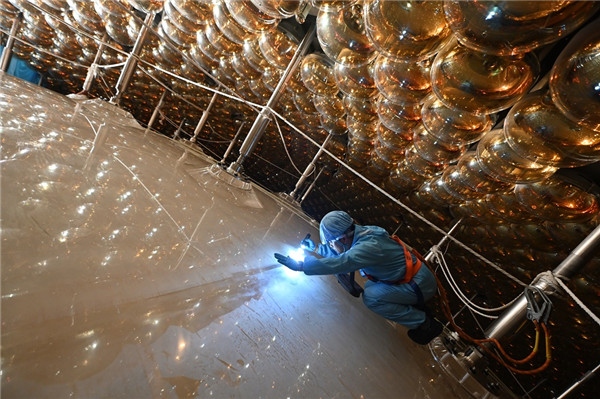
The central acrylic sphere and PMTs. [Photo provided to chinadaily.com.cn]
"The completion and operation of the JUNO detector mark a historic milestone, as it is the first major scientific facility of its scale and precision dedicated to neutrino research worldwide. JUNO will enable us to answer fundamental questions about the nature of matter and the universe," said Wang Yifang, an academician at the Chinese Academy of Sciences.
Compared to the best international level, the volume of JUNO's liquid scintillator has increased by 20 times. In addition, its determination of the mass ordering is independent of matter effects in the Earth and largely free of parameter degeneracies, enabling a threefold increase in photoelectron yield and achieving an unprecedented energy resolution of 3 percent.
Li Yufeng, a researcher at the Institute of High Energy Physics of CAS, said that JUNO is designed to determine the mass ordering of the three neutrino types, whose total mass is less than 0.12 electron volt, or about one-millionth of an electron's mass. The nearly massless nature of neutrinos makes them challenging to study, yet understanding them may help explain fundamental mysteries of atomic composition and cosmic evolution.
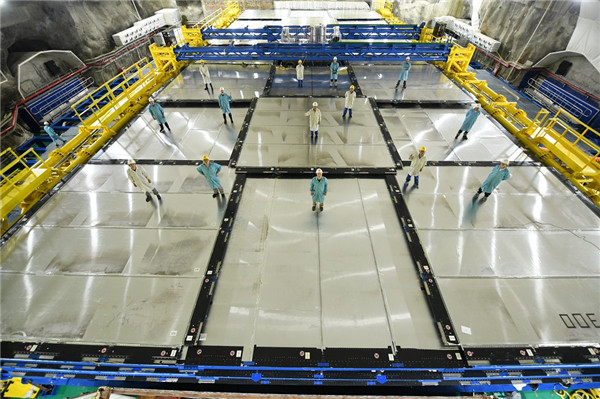
Top tracker above the water pool. [Photo provided to chinadaily.com.cn]
Beginning underground construction in 2015, JUNO started filling 60,000 metric tons of ultrapure water in December. Over the past six months, 20,000 tons of liquid scintillator have been filled into the 35.4-meter diameter acrylic sphere located at the center of a 44-meter-deep water pool. The sphere is surrounded by 45,000 photomultiplier tubes, and the liquid scintillator displaced the water during filling. This part is the core of JUNO, with the liquid scintillator acting as both the interaction medium and signal converter for neutrino detection, Li noted.
"When neutrinos pass through, they sometimes interact with nuclei or electrons, creating charged particles. These particles excite the scintillator molecules, emitting faint flashes of light called scintillation photons," Li said.
"The high transparency of the liquid allows these photons to reach surrounding photomultiplier tubes, which convert the light into electrical signals. By analyzing the timing, intensity and spatial distribution of these signals, scientists can reconstruct neutrino interactions, measure their energies and identify their types," he added.
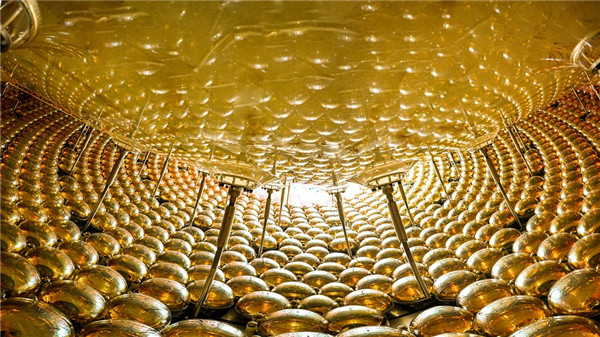
The central acrylic sphere and PMTs. [Photo provided to chinadaily.com.cn]
JUNO is designed for a scientific lifetime of up to 30 years, with a credible upgrade path planned for 2030 to enable a world-leading search for neutrinoless double-beta decay and probe the absolute neutrino mass scale, Li said.
Hosted by the Institute of High Energy Physics, the construction of JUNO involves more than 700 researchers from 74 institutions across 17 countries and regions.
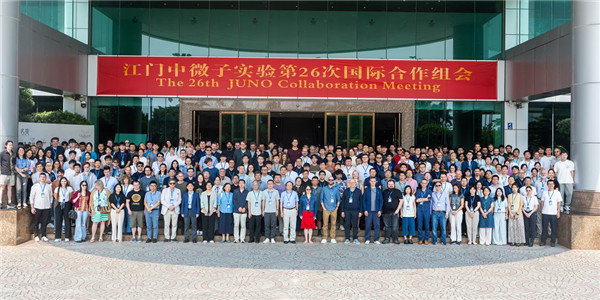
Members who attend the 26th JUNO Collaboration Meeting. [Photo provided to chinadaily.com.cn]
"The landmark achievement that we announce today is also a result of the fruitful international cooperation ensured by many research groups outside China, bringing to JUNO their expertise from previous liquid scintillator setups," said Gioacchino Ranucci, a professor at the University of Milano and INFN-Milano in Italy who participated in the construction of JUNO.
"The worldwide liquid scintillator community has pushed the technology to its ultimate frontier, opening the path toward the ambitious physics goals of the experiment," Ranucci added.
Prior to JUNO, China's first-generation neutrino detector, the Daya Bay Neutrino Experiment, also located in Guangdong province, operated from 2011 to 2020. It discovered the third mode of neutrino oscillation, confirming the standard three neutrino mixing paradigm. This was recognized by Science magazine as one of the Top 10 Scientific Breakthroughs of 2012.
郑重声明:本则消息未经严格核实,也不代表本站观点,本站不承担任何法律责任。


 最新热点
最新热点
-
以色列炮击加沙城致至少6人死亡

以色列炮击加沙城致至少6人死亡
最新热点中新社北京12月20日电 综合消息:以色列军队当地时间19日晚炮击加沙城东部图法居民区,造成至少6名巴勒斯坦人死亡。 据巴勒斯坦通讯社消息,以军当日对图法居民...
-
广东迎来红叶最佳观赏季
广东迎来红叶最佳观赏季
最新热点每年的11月至次年的1月是广东赏叶的好时节,广东多地如广州、肇庆、韶关、江门、清远、河源、梅州的红叶和彩叶已陆续登场,一年一度最色彩斑斓的赏叶季应时而来,吸引了...
-
展现深圳腾飞“奇迹”!总台首部原创精品短剧集《奇迹》定档12月22日
展现深圳腾飞“奇迹”!总台首部原创精品短剧集《奇迹》定档12月22日
最新热点12月20日,中央广播电视总台携手深圳共创的首部原创精品短剧集《奇迹》宣布定档,将于12月22日至明年1月12日在央视一套晚黄金时段跨年播出。 《...
-
骐骥驰骋!2026年总台马年春晚吉祥物发布
-
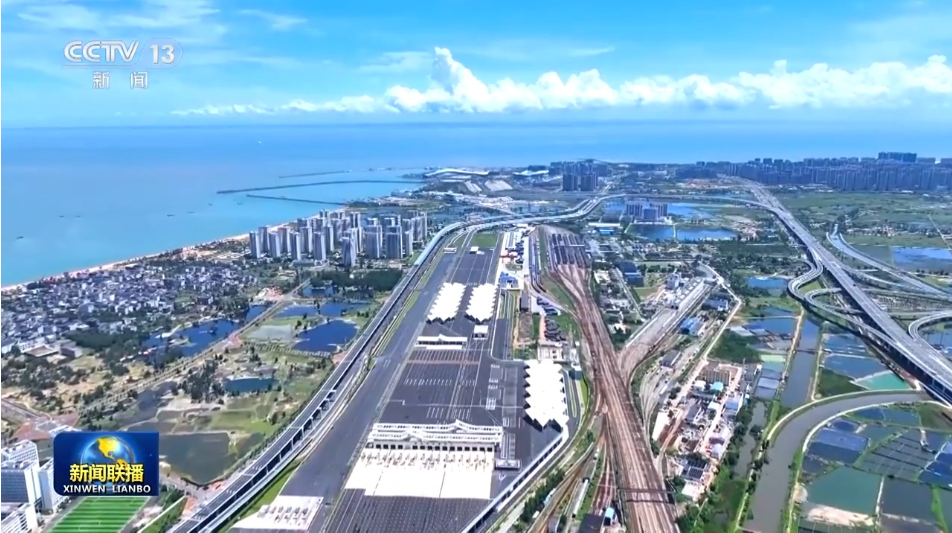
新思想引领新征程丨海南自贸港全岛封关打造引领新时代对外开放重要门户
新思想引领新征程丨海南自贸港全岛封关打造引领新时代对外开放重要门户
最新热点习近平总书记指出:“今年12月18日海南自由贸易港正式启动全岛封关,这是我国坚定不移扩大高水平对外开放、推动建设开放型世界经济的标志性举措。...
 VIP展示
VIP展示
 华侨之声
华侨之声
 海南自贸港启动全岛封关
 山水有根,鄉愁有聲——寫給韶關
 中国时速350公里高铁最长隧道贯通
 中国成功发射卫星互联网低轨14组卫星