

Geng Funeng: Upholding Tradition and Embracing Innovation to Expand Traditional Chinese Medicine Globally
2026-10-23 02:20:50
|
来源:CNS
Chengdu, Sichuan, Oct. 17 (CNS) -- “Our core mission is to do good and make good medicine, and my greatest wish is to bring traditional Chinese medicine (TCM) to the world.”
On Oct. 16, Geng Funeng, a deputy to the National People's Congress and chairman of Good Doctor Group, spoke about the internationalization of TCM and its entry into overseas markets during a joint interview with representatives and journalists from 20 overseas Chinese-language media outlets from countries including the United States, Australia and Thailand. He shared the company's practical experience and insights into bringing TCM to the global market.
On Oct. 16, Geng Funeng, a deputy to the National People's Congress and chairman of Good Doctor Group, spoke about the internationalization of TCM and its entry into overseas markets during a joint interview with representatives and journalists from 20 overseas Chinese-language media outlets from countries including the United States, Australia and Thailand. He shared the company's practical experience and insights into bringing TCM to the global market.
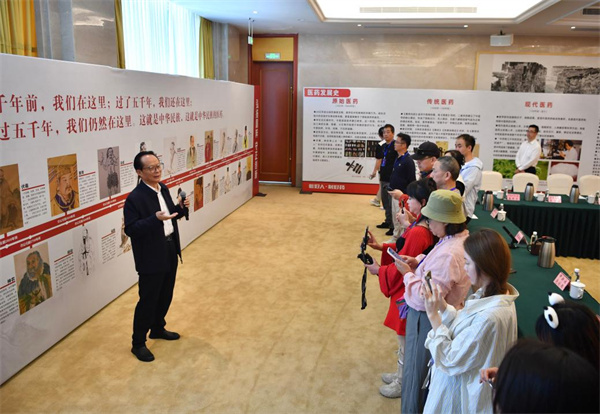
Geng Funeng speaks with representatives of overseas Chinese-language media outlets during a joint interview. Photo by Wang Lei.
Good Doctor Group has been deeply engaged in the TCM industry for four decades, with operations spanning pharmaceutical research and manufacturing, internet-based healthcare, the cultivation of Chinese medicinal herbs, and the deep processing of agricultural products. The company's connection with Periplaneta americana, commonly known as the American cockroach, led to the development of its flagship product, Kangfuxin Liquid. After three decades of continued research, the product has seen its potential clinical applications further explored, becoming an important vehicle for the company's efforts to expand TCM into overseas markets.
During the interview, Huang Mei, vice president of Spain-based La Voz China, raised a challenge shared by many in the industry: the greatest obstacles to taking TCM overseas lie not in its efficacy, but in standards, scientific evidence and regulatory alignment. She asked what practical steps the company had taken to address these challenges.
Geng stressed that standardization is the first major hurdle. Raw materials collected from the wild or purchased on the market can vary considerably in quality from year to year due to differences in sunlight, soil and rainfall. Such fluctuations make it difficult to ensure consistency and control over raw materials. Only by strengthening the entire industrial chain, he said, can these standardization challenges be addressed.
Geng's work in Liangshan Yi Autonomous Prefecture offers one example of the company's efforts to establish standardized production. In Butuo County, Liangshan, the company has established an aconite cultivation base certified under China's Good Agricultural Practice (GAP) standards and developed Liangfu No. 1, the first new aconite variety in Liangshan. Taking advantage of the area's abundant sunshine and large day-to-night temperature differences, the company has also built Asia's largest deep-processing base for concentrated pomegranate juice. Its 12 production lines process the fruit locally, with products exported to Europe, Australia and Southeast Asia, among other markets.
In Geng's view, supporting rural revitalization through industry means more than making donations. It means building an integrated chain of cultivation, processing and exports in local communities, turning regionally distinctive raw materials into products for international markets. “Only by embedding standards in the soil where the herbs are grown can authentic medicinal materials gain the confidence to reach the world,” he said.
“If TCM relies solely on traditional experience, we will be at a disadvantage in international market competition,” Geng said when Cao Mingquan, president of South Korea-based Xinhua News, asked how original Class 1 new drugs derived from Chinese medicine could compete globally.
Geng emphasized the importance of scientific research and innovation. “Does TCM work? What makes it work? How does it work? What exactly happens in the process?” he asked. He argued that research into traditional medicine should use modern scientific methods, logical approaches and tools to identify the molecular basis of medicinal effects and investigate the mechanisms behind them.
He also proposed working with major pharmaceutical companies overseas and reaching agreements through licensing arrangements. Such cooperation could help clarify development strategies for international markets and enable overseas partners to better understand the targets, pathways and mechanisms involved in therapeutic effects and tissue repair. In this way, TCM could become a health resource shared by people around the world.
Promoting TCM overseas, however, is a more complex undertaking that requires coordinated efforts across multiple fields.
Lu Hongyun, general manager of Thailand's Eyes on Thailand, raised a question based on the local market for natural herbal products: Could Kangfuxin Liquid enter Thailand by prioritizing topical applications, following a market-entry approach used by local products? Li Mao'e, editor-in-chief of South Korea-based The World Qiao Post, suggested another possibility. Given the prence of gastrointestinal problems associated with dietary habits in South Korea, could the product be exported as a health supplement to simplify customs clearance procedures?
In response to these practical suggestions from overseas Chinese-language media representatives, Geng acknowledged the limitations of the health supplement route. “Although the procedures for health supplements are relatively straightforward, they cannot make claims about efficacy. They can easily become products that have no effective way of communicating their value, making market promotion difficult,” he said.
Geng said the company had completed product registration in Canada. However, entering mainstream overseas markets is a systematic undertaking that requires far more than the efforts of a single company. He expressed hope that multiple parties in countries participating in the Belt and Road Initiative could work together to help establish regulatory systems for traditional medicine in overseas markets.
“We hope to use overseas Chinese-language media as a bridge to connect with local drug regulatory authorities, university experts and mainstream hospitals, and to facilitate in-depth academic exchanges. We also hope to complete local clinical validation of efficacy in the relevant countries and produce scientific papers whose findings can be independently replicated. In addition, we want to explore building pilot-scale production facilities and establishing local filling and packaging operations overseas, rather than simply importing finished products,” Geng said.
He added that bringing TCM abroad should not be a matter of simply introducing products without deeper engagement. The goal is to help local people genuinely understand its value and develop an appreciation for TCM.
Over the past four decades, Geng has sought to strengthen the foundations of the entire industrial chain at home while building bridges for dialogue between Chinese and international pharmaceutical sectors. Through an approach that upholds tradition while embracing innovation, he has explored practical ways to expand TCM overseas in a sustainable, high-quality manner.
In Geng's view, taking TCM overseas is never simply a matter of exporting products. It is a long journey that requires the combined support of standardized production, scientific evidence, regulatory frameworks and cultural acceptance.
“We remain committed to upholding tradition without clinging to the past, and to embracing innovation without losing sight of our roots. We hope TCM can cross mountains and seas to become a health resource that benefits people around the world,” Geng said. (End)
郑重声明:本则消息未经严格核实,也不代表本站观点,本站不承担任何法律责任。
 最新热点
-
李强同泰国总理会谈
-
科斯塔:欧洲五国及欧盟机构将参与下一轮乌克兰问题谈判
科斯塔:欧洲五国及欧盟机构将参与下一轮乌克兰问题谈判
最新热点当地时间11月13日,欧盟领导人非正式会议在爱尔兰首都都柏林举行。欧洲理事会主席科斯塔在会议结束后表示,欧盟各成员国领导人当天一致同意,德国、法国、意大利、波兰...
-
韩正访问格鲁吉亚
-
韩正出席《联合国气候变化框架公约》第三十一次缔约方大会安塔利亚领导人峰会并作国别发言

韩正出席《联合国气候变化框架公约》第三十一次缔约方大会安塔利亚领导人峰会并作国别发言
最新热点央视新闻客户端消息(新闻联播):当地时间11月8日至12日,习近平主席特别代表、国家副主席韩正赴土耳其出席《联合国气候变化框架公约》第三...
-
外媒:伊拉克库区天然气田遭不明来源无人机袭击

外媒:伊拉克库区天然气田遭不明来源无人机袭击
最新热点中新网11月9日电 据卡塔尔半岛电视台等外媒报道,伊拉克库尔德自治区(库区)安全部门消息人士称,位于伊库区苏莱曼尼亚省的豪尔穆尔天然气田遭不明来源的无人机袭击,...
 VIP展示
 华侨之声
 “红鹰”编队飞越长春 贺空军成立77周年
 粤港澳大湾区科技成果荟上线运行
 纪念台湾光复81周年座谈会在福州举办
 谷神星一号海射型遥八运载火箭发射成功